DWDM QSFP-DD ZR+ DCO Optical Module
Digital Coherent Optical Transceiver Module
DWDM QSFP-DD ZR+ DCO Optical Modules
F-tone offers a comprehensive range of pluggable optical modules in the F-tone®
pluggables portfolio. The wide variety of modules gives you flexible and cost-effective
options for all types of interfaces. F-tone offers a range of GBIC, SFP, XFP, SFP+, CXP,
CFP, F-tone CPAK, and QSFP+ pluggable modules. These small, modular optical interface
transceivers offer a convenient and cost-effective solution for an array of applications in
the data center, campus, metropolitan-area access and ring network, storage area
network, and long-haul network. In recent times, with longer strides of innovation. The
latest addition to the F-tone portfolio pushes this boundary further with the introduction of
the DWDM QSFP-DD ZR+ DCO OPTICAL MODULE.
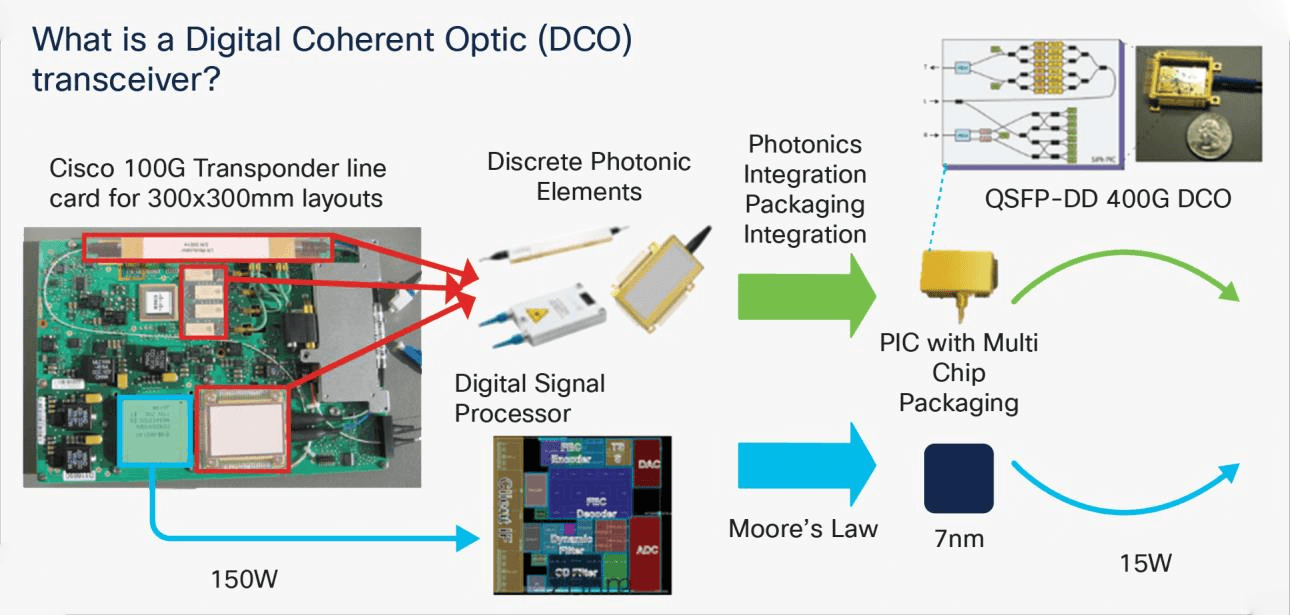
Figure 1. From Discrete components to Integrated Coherent Pluggable
V 3.06
1 /8
Product overview
F-tone now offers a range of all new DWDM QSFP-DD ZR+ DCO transceivers. F-tone already offers a range of
Digital Coherent CFP2 transceivers capable of supporting up to a 200-Gbps wavelength. Thanks to the
miniaturization of the technology with a 7-nm manufacturing procedure and innovation in silicon photonic
technology, it is now possible to squeeze a 400G-capable Digital Coherent WDM interface within a QSFP-DD
form factor.
Two product variants are available:
1. ZR variant
2. ZR Plus variant
QDD ZR overview
The QSFP-DD ZR variant complies with OIF MSA, allowing to provide compatibility with the equivalent
component compliant with the same MSA standard. The key application for the ZR standard is allowing the
transmission of a 400G wavelength in point-to-point topology up to a distance of 120 km with the Mux/Demux
and Amplifier as depicted the below.
Figure 2. QSFP DD ZR Application
In this product variant, the pluggable can support both a 400GE and 4x 100GE interface with the host card.
QDD ZR Plus overview
The QSFP-DD ZR Plus variant complies with OpenZR+ MSA, allowing to cope for distances going from regional
to long haul with multiple amplification sites between the end point. This variant is also providing multiple
configuration options in terms of Modulation scheme, TX filter shaping, and baud rates on top of what OpenZR+
MSA defines.
This variant is also the one capable of reaching the longest transmission distance thanks to the high-performing
O-FEC algorithm.
It is able to support an ~60G baud rate, QPSK, and 8-QAM and 16-QAM modulation scheme to cope with a
200G (QPSK), 300G (8-QAM), and 400G (16-QAM) per wavelength transmission capacity.
It is also capable of supporting 100G signals leveraging QPSK modulation scheme at ~30G baud as well as
200G signal at 16-QAM (~30Gbaud) and 8-QAM (~40 Gbaud).
From the signal shapingmode of view, two different configurations are supported (with or without Tx shaping)
to cope with different filtering requirements.
V 3.06
2 /8
Features and benefits
As line card ports become universal, it is possible to design new line cards optimized for 400G, knowing that by
simply replacing the pluggable, the port can support bitrates down to 100G to guarantee backward
compatibility with previous-generation routers. In addition, the IPoDWDM options, available by simply using the
400G ZR/ZR+ optics, provides, for the first time, the same density of grey line cards, eventually solving the
usual dilemma of having to choose between the benefits of integration and maximizing the throughput of router
line cards.
Some network operators chose to take a different approach at 400G upon recognizing the lessons learned from
the efforts at 100G. In late 2016, these network operators and a few vendors identified 400G as an intersection
point for the industry to support coherent optics in the same form factors as emerging high-volume client
optics, such as QSFP-DD. In less than one year, the OIF defined most of the 400ZR interface technical details,
which helped motivate increased industry investment in pluggable, interoperable coherent interfaces.
A key requirement was to accommodate hyperscale DCI links beyond 120 km, while maintaining the same
QSFP-DD/OSFP form factors. A survey of 400G standardization efforts pointed to elements of OpenROADM
that could provide a standard-based, high-performance addition to the 400ZR standard. Thus, the industry
began looking at the next logical step, which would be to combine these vetted specifications and achieve the
goal of addressing 400G Ethernet-centric solutions beyond 120 km. This would enable the extension of
hyperscale DCIs beyond the edge to regional distances, and expand the addressable market for module
suppliers, providing greater economies of scale that benefit the entire distribution chain. This combination of the
400ZR standard with elements of OpenROADM became known as OpenZR+.
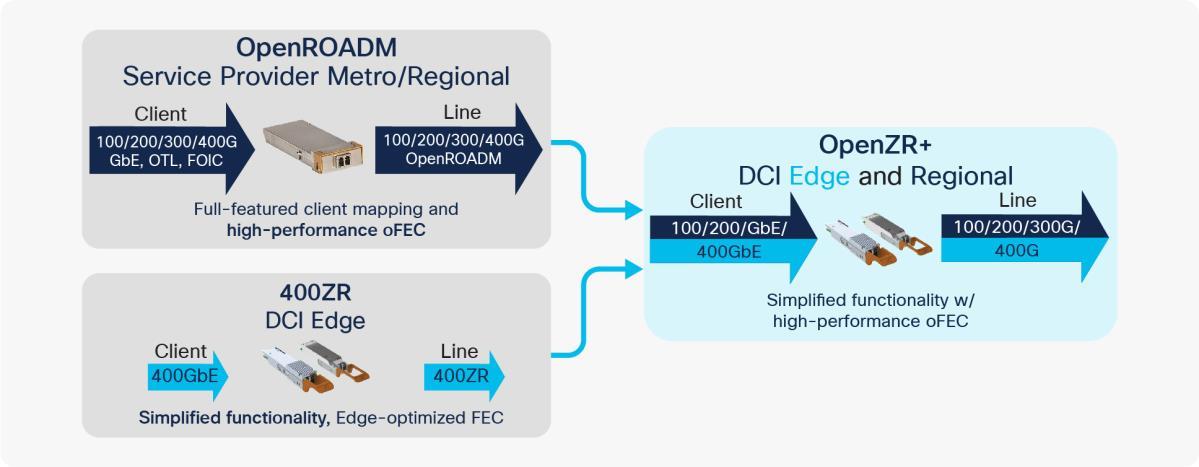
Figure 3.
OpenZR+ is the logical combination of two industry standardization efforts that enables high-performance DCI pluggable
modules supporting multivendor interoperability.
V 3.06
3 /8
As illustrated in Figure 1, OpenZR+ is a combination of two industry standardization efforts created to maintain
the simple Ethernet-only host interface of 400ZR while adding support for features such as: (1) higher coding
gain using oFEC from the OpenROADM standard, which extends the reach capability; (2) multirate Ethernet,
which enables the multiplexing of 100GbE and 200GbE clients over the line-side link, providing optimization
options for the switch/router equipment to channelize the traffic over the transport link; (3) adjustable 100G,
200G, 300G, or 400G line-side transport links (using QPSK, 8QAM, or 16QAM modulation), which enables
reach/capacity optimization over various fiber links; and (4) higher dispersion tolerance. All of these enhanced
capabilities would exist in a QSFP-DD designed to utilize OpenZR+, supporting reaches well beyond the 120
km supported by 400ZR.
The table below summarizes the benefits of modules designed to use OpenZR+, compared to 400ZR and
OpenROADM.
400ZR OpenROADM OpenZR+
Target Application Edge DCI Carrier Metro/LH Regional DCI
Client Traffic 400GbE only 100-400GbE & OTN 100-400GbE Multirate
Reach ≤120km >120km* >120km*
Form Factor QSFP-DD/OSFP CFP2 or other QSFP-DD/OSFP
SD-FEC CFEC oFEC oFEC
*Distance depending on adopted WDM Transport system
Multivendor interoperability
Extensive system-level testing and unmatched technical expertise enable F-tone optics to be successfully use
d across F-tone as well as multivendor platforms. The strategic supply chain diversity and service capabilities
provide the high network availability and peace of mind.
Flexible modulation
As in the case of QSFP+, QSFP56-DD will provide the capability to support lower bitrates, via 4x 100G
pluggables. In addition, this pluggable supports the downsize to the port to 200G (or 2x 100G). This one
pluggable fit’s all type of approach provides great benefits to both vendors and customers, as it enables a
simplification in the IP router portfolio and, as a consequence, a simplification in network planning and
spare parts.
V 3.06
4 /8
| 4 | 00ZR | OpenROADM | OpenZR+ |
| Target Application E | dge DCI | Carrier Metro/LH | Regional DCI |
| Client Traffic 4 | 00GbE only | 100-400GbE & OTN | 100-400GbE Multirate |
| Reach ≤ | 120km | >120km* | >120km* |
| Form Factor Q | SFP-DD/OSFP | CFP2 or other | QSFP-DD/OSFP |
| SD-FEC C | FEC | oFEC | oFEC |
Specification
Transmitter specifications
Both QDD ZR and ZR+ supports full C band tune ability. Tx parameter specifications are showed in the table
below.
Product ID Max Transmit Power Symbol Rate Modulation
(+/-20ppm)
FEC OOB OIB
(Payload) OSNR OSNR
Without TX Shaping: 60,138,546,798 16-QAM (400G) OFEC 42 dB 42 dB
DWDM QSFP-DD ZR
+ DCO
-8.0 (Typ)
-10.0 (Worst case)
With TX Shaping:
-11.0 (Typ)
-13.0 (Worst case)
Without TX Shaping: 60,138,546,798 8-QAM (300G) OFEC 42 dB 42 dB
-8.6 (Typ)
-10.2 (Worst case)
With TX Shaping:
-10.4 (Typ)
-11.9 (Worst case)
Without TX Shaping: 60,138,546,798 QPSK (200G) OFEC 42 dB 42 dB
-6.2 (Typ) -7.7
(Worstcase)
With TX Shaping:
-9.0 (Typ)
-10.5 (Worst case)
TX shaping only: 40,092,364,532 8-QAM (200G) OFEC 42 dB 42 dB
-9.0 (Typ)
-11 (Worst case)
TX shaping only: 30,069,273,399 16-QAM (200G) OFEC 42 dB 42 dB
-8.0 (Typ)
-10(Worst case)
Without TX shaping 30,069,273,399 QPSK (100G) OFEC 42 dB 42 dB
only:
-5.9 (Typ)
-7.5 (Worst case)
V 3.06
5 /8
| Product ID | Max Transmit Power | Symbol Rate (+/-20ppm) |
Modulation (Payload) |
FEC | OOB OSNR |
OIB OSNR |
| DWDM QSFP-DD ZR + DCO |
Without TX Shaping: -8.0 (Typ) -10.0 (Worst case) With TX Shaping: -11.0 (Typ) -13.0 (Worst case) |
60,138,546,798 | 16-QAM (400G) | OFEC | 42 dB | 42 dB |
| Without TX Shaping: -8.6 (Typ) -10.2 (Worst case) With TX Shaping: -10.4 (Typ) -11.9 (Worst case) |
60,138,546,798 | 8-QAM (300G) | OFEC | 42 dB | 42 dB | |
| Without TX Shaping: -6.2 (Typ) -7.7 (Worstcase) With TX Shaping: -9.0 (Typ) -10.5 (Worst case) |
60,138,546,798 | QPSK (200G) | OFEC | 42 dB | 42 dB | |
| TX shaping only: -9.0 (Typ) -11 (Worst case) |
40,092,364,532 | 8-QAM (200G) | OFEC | 42 dB | 42 dB | |
| TX shaping only: -8.0 (Typ) -10(Worst case) |
30,069,273,399 | 16-QAM (200G) | OFEC | 42 dB | 42 dB | |
| Without TX shaping only: -5.9 (Typ) |
30,069,273,399 | QPSK (100G) | OFEC | 42 dB | 42 dB | |
| -7.5 (Worst case) |
Rx parameter specifications
Product ID Modulation RX OSNR S
(Payload)
RX Extended
ensitivity ( Sensitivity Range RX Se
dB) Optimal nsitivity (1dB
OSNR Penal
RX Power
Sensitivity (No AS
ty)
Max Rx Po
E Noise)
CD Robustness (
wer ps/nm)
16-QAM (4 DWDM QSFP-DD ZR+ Without TX
DCO 00G) Shaping: 2
3.7
With TX Sh
-12dBm -16dBm Without TX 13dBm
Shaping:
-20dBm
With TX Shaping:-
21dBm
aping: 23.1
Default:+/-
13,000
Configurable up
to: +/-52,000
8-QAM (30
Without TX
0G)
Shaping: 2
0.8
With TX Sh
-15dBm -19dBm Without TX 13dBm
Shaping:
-22dBm
With TX Shaping:-
23dBm
aping: 19.5
Default: +/-
26,000
Configurable up
to:+/-100,000
QPSK
(200G) Without TX
Shaping:15
.3
With TX Sh
-18dBm -22dBm -28dBm 13dBm
aping: 15.0
Default: +/-
50,000
Configurable up
to:+/-100,000
8-QAM (20 17.4 (Only
0G) TX
shaping
supported
-16dBm -20dBm -28dBm 13dBm
)
Default: +/-
26,000
Configurable up
to: +/-100,000
16-QAM (2 19.3 (Only
00G) TX
shaping
supported
-15dBm -20dBm -24dBm 13dBm
)
Default: +/-
21,000
Configurable up
to: +/-85,000
QPSK 11.8 (No T
(100G)
-20dBm -25dBm -28dBm 13dBm
x
shaping)
Default: +/-
80,000
Configurable up
to: +/-160,000
V 3.06
6 /8
| Product ID | Modulatio (Payload) |
n RX OSNR ensitivity ( dB) |
S RX Sensitivity Optimal |
Extended Range RX Se nsitivity (1dB OSNR Penal ty) |
RX Power Sensitivity (No AS E Noise) |
Max Rx Po wer |
CD Robustness ( ps/nm) |
| DWDM QSFP-DD ZR+ DCO |
16-QAM 00G) |
(4 Without TX Shaping: 2 3.7 With TX Sh aping: 23.1 |
-12dBm | -16dBm | Without TX Shaping: -20dBm With TX Shaping:- 21dBm |
13dBm | Default:+/- 13,000 Configurable up to: +/-52,000 |
| 8-QAM (3 0G) |
0 Without TX Shaping: 2 0.8 With TX Sh aping: 19.5 |
-15dBm | -19dBm | Without TX Shaping: -22dBm With TX Shaping:- 23dBm |
13dBm | Default: +/- 26,000 Configurable up to:+/-100,000 |
|
| QPSK (200G) |
Without TX Shaping:15 .3 With TX Sh aping: 15.0 |
-18dBm | -22dBm | -28dBm | 13dBm | Default: +/- 50,000 Configurable up to:+/-100,000 |
|
| 8-QAM (2 0G) |
0 17.4 (Only TX shaping supported ) |
-16dBm | -20dBm | -28dBm | 13dBm | Default: +/- 26,000 Configurable up to: +/-100,000 |
|
| 16-QAM 00G) |
(2 19.3 (Only TX shaping supported ) |
-15dBm | -20dBm | -24dBm | 13dBm | Default: +/- 21,000 Configurable up to: +/-85,000 |
|
| QPSK (100G) |
11.8 (No T x shaping) |
-20dBm | -25dBm | -28dBm | 13dBm | Default: +/- 80,000 Configurable up to: +/-160,000 |
Rx Optical Polarization specifications
Product ID Modulation (Paylo State of
ad) Polarization
Change rate w/1d
State of
Polarization
Change rate w/ 0.5
B of OSNR
State of
Polarization
Change rate w/ 2d
d
B of OSNR penalty
penalty
DGD Robustness (
ps)
B of OSNR
penalty
16-QAM (400G) 80 rad/ms 150 rad/ms 200 rad/ms 60
DWDM QSFP-DD
ZR+ DCO
8-QAM (300G) 120 rad/ms 200 rad/ms 300 rad/ms 60
QPSK (200G) 800 rad/ms 1000 rad/ms 1400 rad/ms 60
8-QAM (200G) 70 rad/ms 100 rad/ms 150 rad/ms 60
16-QAM (200G) 50 rad/ms 100 rad/ms 150 rad/ms 60
QPSK (100G) 400 rad/ms 500 rad/ms 800 rad/ms 80
Rx Multichannel Interaction specifications
Product ID Modulation (Payload) Multichannel Xtalk tolerance by Multichannel Xtalk OSNR penalty
15 additional channels induced by 2 adjacent channels
16-QAM (400G) 15db with OSNR oenalty ≤ 0.5dB 0.5 dB ( adjacent chs at 75Ghz)
DWDM QSFP-DD ZR+
DCO
8-QAM (300G) 15db with OSNR oenalty ≤ 0.3dB 0.3 dB ( adjacent chs at 75Ghz)
QPSK (200G) 15db with OSNR oenalty ≤ 0.3dB 0.2 dB ( adjacent chs at 75Ghz)
8-QAM (200G) 15db with OSNR oenalty ≤ 0.3dB 0.7 dB ( adjacent chs at 50Ghz)
16-QAM (200G) 15db with OSNR oenalty ≤ 0.3dB 0.8 dB ( adjacent chs at 50Ghz)
QPSK (100G) 17db with OSNR oenalty ≤ 0.35dB 0.6 dB ( adjacent chs at 37.5Ghz)
V 3.06
7 /8
| Product ID | Modulation (Paylo ad) |
State of Polarization Change rate w/ 0.5d B of OSNR penalty |
State of Polarization Change rate w/1d B of OSNR penalty |
State of Polarization Change rate w/ 2d B of OSNR penalty |
DGD Robustness ( ps) |
| DWDM QSFP-DD ZR+ DCO |
16-QAM (400G) | 80 rad/ms | 150 rad/ms | 200 rad/ms | 60 |
| 8-QAM (300G) | 120 rad/ms | 200 rad/ms | 300 rad/ms | 60 | |
| QPSK (200G) | 800 rad/ms | 1000 rad/ms | 1400 rad/ms | 60 | |
| 8-QAM (200G) | 70 rad/ms | 100 rad/ms | 150 rad/ms | 60 | |
| 16-QAM (200G) | 50 rad/ms | 100 rad/ms | 150 rad/ms | 60 | |
| QPSK (100G) | 400 rad/ms | 500 rad/ms | 800 rad/ms | 80 |
| Product ID | Modulation (Payload) | Multichannel Xtalk tolerance by 15 additional channels |
Multichannel Xtalk OSNR penalty induced by 2 adjacent channels |
| DWDM QSFP-DD ZR+ DCO |
16-QAM (400G) | 15db with OSNR oenalty ≤ 0.5dB | 0.5 dB ( adjacent chs at 75Ghz) |
| 8-QAM (300G) | 15db with OSNR oenalty ≤ 0.3dB | 0.3 dB ( adjacent chs at 75Ghz) | |
| QPSK (200G) | 15db with OSNR oenalty ≤ 0.3dB | 0.2 dB ( adjacent chs at 75Ghz) | |
| 8-QAM (200G) | 15db with OSNR oenalty ≤ 0.3dB | 0.7 dB ( adjacent chs at 50Ghz) | |
| 16-QAM (200G) | 15db with OSNR oenalty ≤ 0.3dB | 0.8 dB ( adjacent chs at 50Ghz) | |
| QPSK (100G) | 17db with OSNR oenalty ≤ 0.35dB | 0.6 dB ( adjacent chs at 37.5Ghz) |
Important Notice
Performance figures, data and any illustrative material provided in this data sheet are
typical and must be specifically confirmed in writing by F-tone Networks before they
become applicable to any particular order or contract. In accordance with the F-tone
Networks policy of continuous improvement specifications may change without notice.
The publication of information in this data sheet does not imply freedom from patent or
other protective rights of F-tone Networks or others. Further details are available from any
F-tone Networks sales representative.
V 3.06
8 /8
Physical
ProductID TempRange MTBF Roundtrip Latency
Operating Case Temperature 442,477 hrs 400GE: 4.7 microsec
range: 15 to +75°C
4x100GE: 5.2 microsec
Short term operating case
temperature range +80°C.
Note: a short term condition is
present for a period of not
more than 96 consecutive
hours and a total of not more
than 15 days in 1 year. This
refers to a total of 360 hours in
any given year, but no more
than 15 occurrences during
that 1-year period.
Note: the module turn up from
cold start at ambient
temperature as low as -5°C
and it will warm up witha case
temperature higher than the
ambient temperature, but it will
meet optical performance
specs only with case
temperature within the range
defined above.
3x100G
E: 6.0 microsec
DWDM QSFP-DD ZR+
DCO
2x100GE: 6.9
microsec
Ordering information
QSFP Double-Density Digital Coherent Optical Modules 400G
Product ID Product Description
DWDM QSFP-DD ZR+ DCO QSFP-DD transceiver module, coherent DCO, 400G-ZR+
| ProductID Tem | pRange | MTBF | Roundtrip Latency |
| Ope DWDM QSFP-DD ZR+ ran DCO Sho tem Not pre mor hou tha refe any tha that Not col tem and tem am me spe tem defi |
rating Case Temperature ge: 15 to +75°C rt term operating case perature range +80°C. |
442,477 hrs | 400GE: 4.7 microsec 4x100GE: 5.2 microsec3x100G E: 6.0 microsec2x100GE: 6.9 microsec |
| e: a short term condition is | |||
| sent for a period of not e than 96 consecutive rs and a total of not more n 15 days in 1 year. This |
|||
| rs to a total of 360 hours in | |||
| given year, but no more n 15 occurrences during 1-year period. |
|||
| e: the module turn up from | |||
| d start at ambient perature as low as -5°C |
|||
| it will warm up witha case | |||
| perature higher than the | |||
| bient temperature, but it will | |||
| et optical performance cs only with case perature within the range ned above. |
| Product ID | Product Description |
| DWDM QSFP-DD ZR+ DCO | QSFP-DD transceiver module, coherent DCO, 400G-ZR+ |

Product Line Declaration: This product is developed and manufactured by F-tone (Beijing) Technology Co., Ltd. (北亿纤通). F-tone is a professional supplier specializing in industrial Ethernet switches, optical modules, and fiber optic connectivity products. All specifications subject to change without notice.
Important Notice: Information provided for reference only. Actual performance may vary. F-tone makes no warranties regarding completeness or accuracy.